Build a Caster-Mounted Workbench That Won't Wobble During Hand Planing
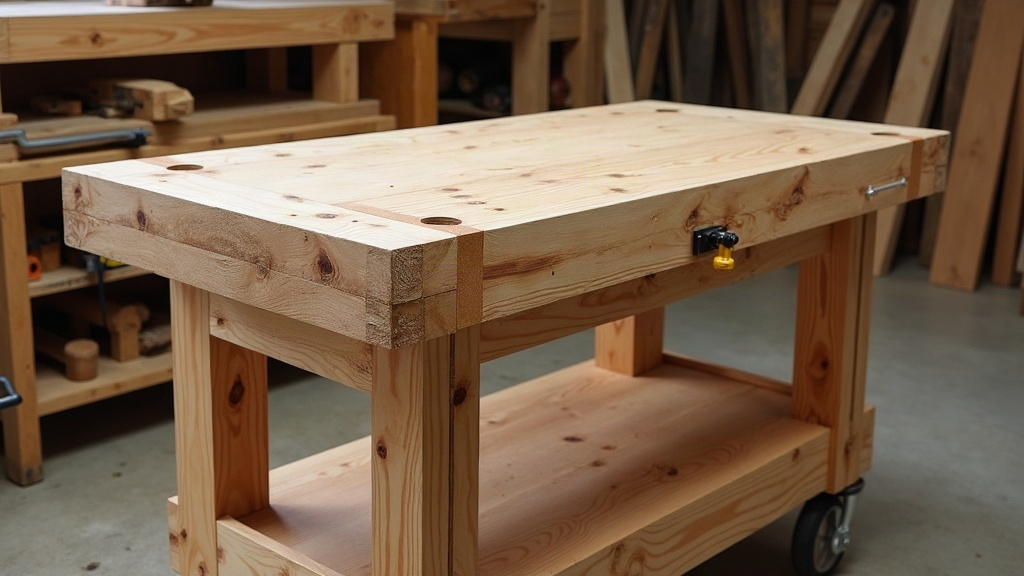
If you’ve ever wound up a serious planing stroke and felt the whole bench skate across the floor, you already know the problem. A caster-mounted workbench can stay rock-solid under hand planing, but getting there takes more than screwing a set of wheels onto the underside of a top. Below is the actual reasoning, hardware, and bracing strategy that lets you roll your bench around the shop one minute and plane like it’s bolted to the slab the next.
Why Mobile Workbenches Usually Fail Under Hand Tools
Most store-bought mobile benches, and plenty of DIY caster jobs, wobble because the casters were tacked on at the end instead of being designed in from the start. Three culprits show up again and again:
- Too much distance between the floor and the benchtop. That extra height acts like a lever arm, turning every forward push into a rocking motion.
- Soft, spring-loaded wheels. Rubber casters flex and absorb lateral force instead of sending it into the frame where it belongs.
- Weak joints between the legs and the caster plates. If that connection flexes, the base and the top are essentially moving independently.
Here’s the thing: hand planing throws a lot more horizontal force at a bench than drilling or sanding ever will. A bench that feels perfectly stable while you’re assembling a drawer can still shimmy the second you lean into a jack plane with any conviction.
Step 1: Choose the Right Casters
Casters are not interchangeable parts, no matter what the hardware aisle suggests. For a bench meant to take planing pressure, you want:
- Total-lock casters that lock both the swivel and the wheel rotation, not the cheaper wheel-only brakes you see on shop stools.
- Hard wheel material. Polyurethane or phenolic wheels push force straight into the frame. Soft rubber just squishes and gives you back the energy as wobble.
- A load rating of at least 300 lbs per caster. Four casters gets you 1,200 lbs of rated capacity, which sounds absurd for a bench that might weigh 200 lbs, but overbuilding here means less deflection when you lean into a stroke.
- A retractable, step-down caster system. This is the single biggest upgrade you can make. The casters lift for rolling and drop the frame straight onto the floor for stationary work. By itself, this change solves the vast majority of wobble complaints people post about online.
Step 2: Build a Retractable Caster System
If you want the single most effective fix, it’s a lever-actuated retractable caster kit, the kind sold by Rockler, Bench Dog, and a handful of other shop-furniture brands. The mechanics are simple:
- Casters sit on a sliding or pivoting bracket mounted under each leg.
- A foot pedal or hand lever lowers the casters so you can roll the bench.
- Release the lever and the legs drop flat onto the floor while the casters lift clear.
Once the legs are bearing the full weight directly, with no wheel axle in the load path, there’s no mechanical flex left to cause wobble. Building one from scratch? A straightforward layout looks like:
- Four corner-mounted retractable units.
- A center cam-lock lever tied to all four units with a rod linkage, so they drop and lift together instead of one at a time.
- Steel mounting plates at least 3/16” thick, bolted through the leg stock, not just screwed in.
Step 3: Design the Base for Rigidity First
Great casters on a flimsy base will still rack side to side. Build rigidity in from the start:
- Diagonal stretchers or X-bracing between the legs, especially along the long axis, since that’s where most planing force lands.
- Through-mortise joints with bolts, not pocket screws, at every leg-to-rail connection.
- A lower shelf loaded with sandbags, concrete pavers, or tool storage. Adding mass low in the frame kills rocking more effectively than almost anything else you can do.
- A torsion-box top (two plywood skins over internal ribs) adds real rigidity without piling on unnecessary weight.
Step 4: Weight and Mass Still Matter
There’s an obvious irony with casters: they make a bench easier to roll, but also easier to shove accidentally. Fight back with mass:
- Aim for a total bench weight somewhere in the 150 to 250 lb range for serious hand-tool work.
- Build a fully enclosed lower cabinet instead of leaving an open shelf. A packed cabinet puts weight right where it resists tipping.
- Load the heavier tool storage toward whichever end of the bench you actually plane at most often.
Step 5: Test Before You Trust It
Don’t just eyeball it. Put it through the paces it’ll actually see:
- Clamp a board down and run full-length, aggressive plane strokes in both directions.
- Watch the base, not the top. Any shift down there is the real tell.
- Re-torque every bolt after a week of use. Wood and steel joints settle during the first several sessions, and a bolt that was snug on day one can loosen noticeably by day seven.
Quick Reference: Wobble-Proofing Checklist
- ✅ Retractable or total-lock casters, no cushioned wheels
- ✅ Diagonal bracing on both axes
- ✅ Bolted (not screwed) leg-to-rail joints
- ✅ Added mass via shelf or cabinet
- ✅ Bench weight 150+ lbs
- ✅ Tested under real planing pressure, not just pushed by hand
Conclusion
A caster-mounted bench really can take aggressive hand planing without flinching. The trick is treating mobility as something that disappears entirely once you’re working, not something you grudgingly put up with. Go with retractable, total-lock casters, build genuine rigidity into the base through diagonal bracing and bolted joints, and pack in enough mass to keep the thing planted. Nail those three things and you’ll end up with a bench that rolls across the shop with one hand and stands dead still the moment steel meets wood.