Upgrading to a Cabinet Table Saw: Is 220V Garage Rewiring Worth It?
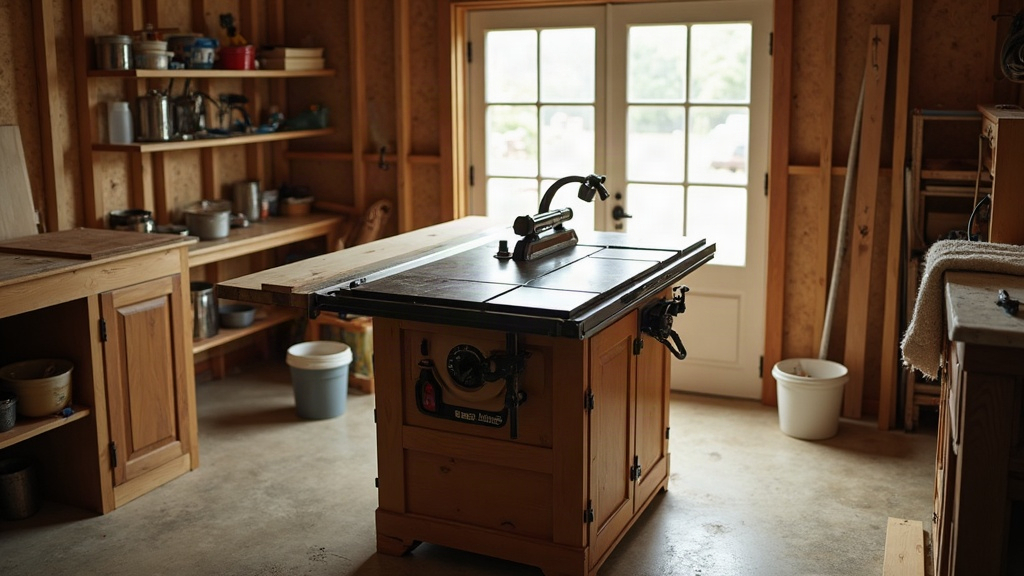
If you’re stepping up from a contractor or hybrid saw to a full-size cabinet saw, the real question isn’t just “which saw do I buy.” It’s “can my garage actually handle it?” Most 3HP+ cabinet saws demand a dedicated 220V (240V) circuit, and that usually means calling an electrician, adding a new breaker, and in some cases upgrading the whole panel. The short answer: yes, it’s worth doing if you plan to keep the saw for years. But what it actually costs you, in money and hassle, depends heavily on how much room your panel has and how far the run is from the breaker box to the saw.
Why Cabinet Saws Need 220V
Contractor saws usually run fine on a 110V/15A circuit because their motors sit around 1.5 to 2HP. Cabinet saws are a different animal. The Grizzly G0690, the Powermatic PM1000, the SawStop PCS, nearly all of them ship with 3HP or bigger motors. Push that much power through 110V and you’d need absurd amperage, plus much thicker wire, just to deliver the same wattage. So manufacturers skip the problem entirely and wire these motors for 220V out of the box.
There’s more to the 220V setup than just “the saw won’t turn on without it”:
- Less voltage drop over long extension cords or runs out to a detached garage
- A cooler motor … 220V motors pull roughly half the amps of an equivalent 110V motor, which means less heat buildup and less wear over time
- Room to grow — once that 220V line exists, adding a dust collector, air compressor, or planer later becomes a much smaller project
What the Rewiring Actually Involves
A standard 220V circuit for a cabinet saw typically needs:
- A dedicated 20A or 30A double-pole breaker (check your saw’s manual first, most 3HP saws call for 20A minimum)
- 10-gauge or 12-gauge wire, picked based on amperage and how far the run stretches
- A NEMA 6-20 or 6-30 outlet that matches your saw’s plug
- Confirmation that your main panel actually has an open double-pole slot, or at least room for a sub-panel
If your panel’s already maxed out, this is where the budget starts climbing fast. You might be looking at a sub-panel, or even a full service upgrade from 100A to 200A if the house is older. That’s a completely different conversation than “just add an outlet,” and it’s worth knowing before you fall in love with a specific saw model.
Real-World Cost Breakdown
| Scenario | Typical Cost (US) |
|---|---|
| Open breaker slot, garage near panel | $150–$350 |
| Long run (detached garage, 50+ ft) | $400–$800 |
| Panel full, needs sub-panel | $600–$1,200 |
| Full service upgrade needed | $1,500–$3,000+ |
Get at least two quotes from licensed electricians before you commit. This kind of wiring is routine, almost boring work for them, so the price swing you’ll see usually comes down to your region, not the actual difficulty of the job.
DIY: Is It Worth the Risk?
If you’re handy with electrical work and your local code allows homeowner permits, running a 220V circuit is honestly one of the friendlier DIY electrical jobs out there. It’s one circuit, not a panel swap, not a rewire of the whole garage. That said, a few things to weigh:
- Pulling a permit and getting it inspected protects you later, whether it’s resale or an insurance claim
- A miswired 220V circuit can fry an expensive motor, or worse, start a fire
- If your panel’s already full, DIY buys you nothing here. You’ll need a pro for the sub-panel regardless
For most woodworkers who don’t do electrical work for a living, handing an electrician $150 to $350 for a straightforward job is cheap insurance next to a $2,000+ saw motor.
Is It Worth It for Your Shop?
A few questions worth asking yourself before you decide:
- Will this saw stay in your shop 5+ years? If so, the one-time wiring cost basically disappears over that span.
- Are more big tools coming — a dust collector, a planer, a compressor? A 220V sub-panel with a few extra outlets future-proofs the whole shop, not just this one machine.
- Renting, or thinking about moving soon? Then it’s worth considering whether the upgrade adds value to the place or just sits there as a sunk cost. For what it’s worth, a properly permitted 220V circuit tends to read as a garage improvement to most buyers, not a red flag.
If you’re serious about fine woodworking, the cut quality, stability, and raw power you get from a cabinet saw are worth the wiring hassle nearly every time. Think of it this way: the rewiring is a fixed cost you pay once. The performance jump from the saw sticks around for as long as you own it.
Conclusion
Stepping up to a cabinet table saw almost always puts the 220V question on your plate, and in most cases, it’s worth tackling head-on. Budget somewhere between $150 and $800 for a typical garage install, more if your panel needs expanding first. Treat it less like an expense tied to one saw and more like an investment in what your shop can do next. Get a licensed electrician’s quote before you actually buy the saw. That way there’s no surprise waiting for you when it shows up on your loading dock.